

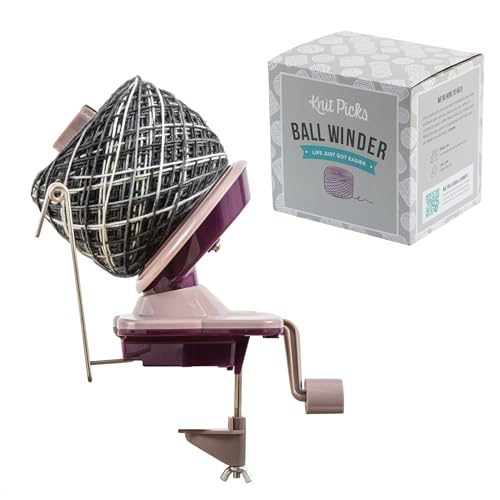

Choose with confidence
How to choose a yarn winder
Begin with a real project rather than the largest machine in a comparison. Look at the weight on your yarn label, the size of the cake you want to make, and whether your yarn comes ready to feed. A compact winder may be enough for small jobs; preparing several larger hanks creates a different set of priorities.
1. Identify the yarn package
An opened hank is a loop of yarn that needs support while it unwinds. A yarn swift does that job. A skein or existing cake may feed without a swift, and some yarn is ready to knit or crochet straight from the package. Rewinding everything is optional, not a requirement for good crafting.
If those names are confusing, start with the cake, skein, hank and ball guide. It explains what changes about preparation for each format.
2. Treat capacity as a starting point
A stated 4 oz or 10 oz capacity describes an approximate amount for a particular model. It does not establish the space occupied by every yarn. A light, bulky strand can fill a cake differently from a denser, finer one. Plan for the cake’s shape and clearance, not weight alone.
The capacity guide explains ounces, grams and bulk. If you are near a model’s limit, check the manufacturer’s guidance or wind a smaller amount rather than forcing a cake to fit.
3. Choose a drive that fits your routine
A manual winder provides direct control through the crank. An electric winder changes that part of the work, but you still prepare the yarn, thread the machine and watch for obstructions. Frequent winding can make powered operation appealing; occasional leftovers may not justify the added setup.
Read the manual-versus-electric comparison for the practical tradeoffs. We do not assume that a motor makes a machine larger, more reliable or appropriate for a medical condition.
4. Measure the entire workspace
Measure the table edge and look underneath it. A lip, rail or drawer may obstruct a clamp even when the tabletop itself seems thin enough. Leave room for the handle, your hands and the rotating swift. Keep an electric stop control within easy reach.
The clamp and table setup guide covers these checks. Our Winder Finder can narrow the options when a documented clamp opening is available; missing measurements are flagged rather than guessed.

