Choose a manual yarn winder when direct pace control, power-free operation and a straightforward tabletop setup fit your routine. A tabletop yarn winder forms a cake: most clamp to a work-surface edge, while one approved large model has a maker-described freestanding option. It is different from a tabletop swift, which supports an opened hank.
Choose around your ordinary yarn packages
Start with the largest skein you regularly need to prepare, not the largest one you might buy someday. A smaller machine can be convenient for modest batches and leftovers. A larger model may avoid splitting some skeins, but it also needs a workable place to stand and store.
Manufacturer mass ratings are starting points rather than universal promises. Two yarns of the same weight can occupy different amounts of space. If a purchase depends on winding a particularly bulky yarn in one cake, look for explicit compatibility guidance instead of relying on ounces alone.
Choose a tabletop manual winder by the job
The craft does not choose the machine: a manual yarn winder for crocheting and one for knitting face the same package-size, yarn-bulk, clamp and workspace questions. Use the exact model evidence below instead of treating every hand crank as interchangeable.
| Option | Choose this when | Skip or verify when |
|---|---|---|
| Knit Picks 82500 | Your packages fit its stated 100 g / 3.5 oz limit and a compact clamp-on tool suits the workspace. | Do not expect the guide to fold back after it is positioned; clamp opening is unverified here. |
| Stanwood YBW-A | About 4 oz is sufficient and the work-surface edge fits its approximately 1¾-inch clamp. | Its setup directions are YBW-A-specific and should not be transferred to other Stanwood models. |
| Stanwood large metal | Recurring larger packages justify about 10 oz of maker-stated capacity and a 2⅛-inch clamp fits. | It needs more working and storage room than a compact winder. |
| Olikraft large metal | A level, clear tabletop may support the maker-described option to rest the winder without its clamp. | Plan from the lower 10 oz claim; the upper 16 oz depends on yarn, clamp opening is unverified, and clamp-free use is not a promise of stability on every surface. |
| Olikraft compact | Up to 4 oz depending on yarn type is enough and its documented 1.75-inch clamp fits your surface. | It is not freestanding and does not inherit the separate large model's 10-to-16-ounce claim or stainless-steel construction. |
Explore the equipment
Compare the documented options and check the exact model before ordering.
As an Amazon Associate I earn from qualifying purchases. How our links work.
Check the table before comparing accessories
Measure the table edge and inspect the underside for an apron, bevel or obstruction. The nominal tabletop thickness is only part of clamp fit. Your hand also needs enough clearance to rotate the crank without hitting the table, another tool or the swift.
Stanwood lists its compact YBW-A at about 4 ounces, with a clamp opening of about 1¾ inches. Its separate large metal model has different specifications. Treat these as distinct products rather than interchangeable sizes of the same mechanism.
| Priority | What to inspect |
|---|---|
| Small workspace | Assembled footprint and crank clearance |
| Larger skeins | Exact model capacity and yarn limitations |
| Frequent setup | How guides, bobbin and clamp assemble |
| Occasional storage | Actual disassembly or storage instructions |
| Longer ownership | Model-specific instructions and available replacement parts |
Look closely at setup and storage
A compact-looking machine is not necessarily designed to fold after every session. Knit Picks says the guide on its current ball winder must be positioned opposite the handle and cannot be moved back once positioned. Check instructions before assuming an arm is a reusable folding feature.
Think about where you will keep the machine assembled. A protected shelf may be easier than repeatedly removing components. Keep the instructions and identifying model information together so a future question about a clamp or guide can be resolved accurately.
Who should skip a manual winder?
If repeated crank turning is the specific task you want to avoid, investigate powered options and their controls. A larger manual machine still requires turning the handle. Conversely, if you mainly use ready-to-work skeins, you may not need a winder at all. Try solving the actual feeding problem before adding another preparation step.
For hank users, include the cost and space of a suitable support arrangement in your choice. The crank produces the cake; it does not hold an opened loop of yarn apart.
Equipment to compare
These choices relate to this guide. Consider the specifications and limitations alongside your own setup.
As an Amazon Associate I earn from qualifying purchases. How our links work.

Stanwood 10 oz metal winder
A hand-operated option for comparing larger stated capacity with a documented clamp opening.
- About 10 oz (maker)
- Clamp to 2⅛ in
Consider: The maker’s approximate 10 oz rating does not guarantee that every bulky yarn will fit.
Check on AmazonPrice, seller and availability are shown on Amazon.

Stanwood YBW-A · 4 oz
A compact hand-crank winder with enclosed gears and model-specific setup instructions.
- About 4 oz (maker)
- Clamp about 1¾ in
Consider: Choose the larger model if your intended cake exceeds this model’s approximate rating.
Check on AmazonPrice, seller and availability are shown on Amazon.
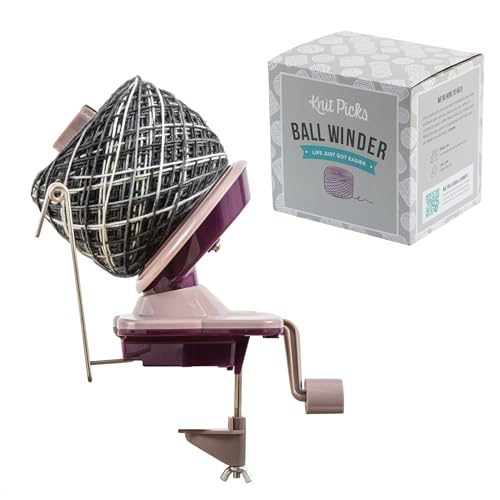
Knit Picks ball winder · Purple
A compact alternative with a stated 100 g capacity for smaller winding jobs.
- 100 g / 3.5 oz (maker)
- Hand operated
Consider: The current instructions say its yarn guide cannot be folded back after it is positioned.
Check on AmazonPrice, seller and availability are shown on Amazon.
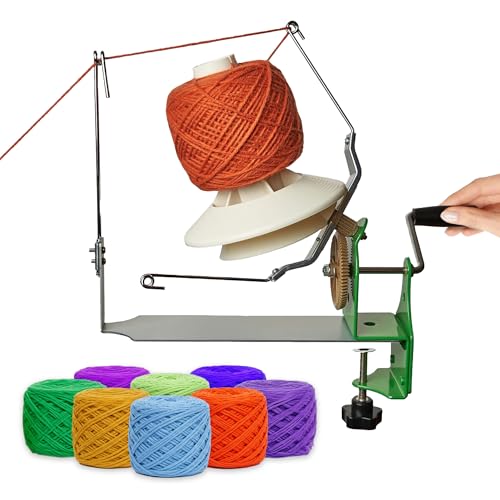
Olikraft large metal winder
A larger hand-operated design; the maker describes a freestanding option as well as a clamp.
- 10–16 oz (maker claim)
- Metal construction
Consider: The maker advertises 10–16 oz without a universal yarn-density basis. Treat the upper figure cautiously.
Check on AmazonPrice, seller and availability are shown on Amazon.
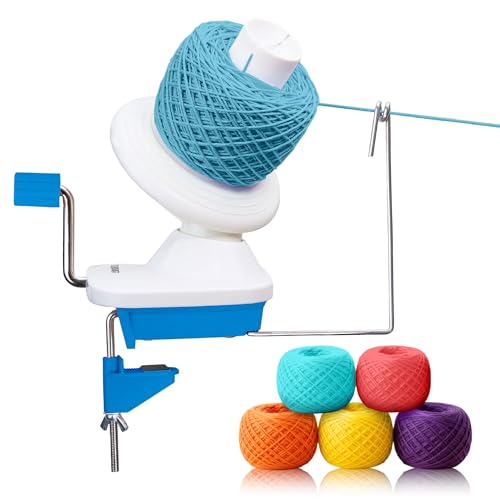
Olikraft compact winder · Ocean Blue
A compact hand-operated winder with a maker-stated 4 oz conditional capacity and 1.75-inch clamp limit.
- Up to 4 oz, depending on yarn type
- Clamps to surfaces up to 1.75 in
Consider: The 4 oz figure depends on yarn type; do not treat it as a guaranteed fit for every bulky yarn.
Check on AmazonPrice, seller and availability are shown on Amazon.
Common questions
Is a metal winder automatically better?
No. Frame material alone does not establish capacity, gear quality or usable clamp fit. Compare the complete documented model.
Can I turn every winder in either direction?
Do not assume so. Follow the stated direction for your model; instructions for another winder may not apply.
Do manual winders need electricity?
The winding motion comes from your hand turning the crank. You still need an appropriate mounting surface and a clear yarn feed.
Sources & further reading
Sources below support the claims identified in this guide. Product details may come from manufacturer documentation or clearly labeled retailer or listing evidence. We have not physically tested these products.
- Stanwood YBW-A specifications
- Knit Picks current ball winder instructions
- Olikraft compact winder specifications
- Olikraft large-capacity winder specifications
Found an error? Send a correction.
Return to our main yarn winder guide to compare winder types, capacity and table fit, or use the Winder Finder to narrow researched candidates.