A wooden yarn winder uses a hand crank to form yarn into a cake, but the wooden frame does not establish capacity, table fit, noise or durability. The current KnitPro family is better documented than the approved LYKKE mango listing, so compare the known mechanism and service parts before choosing by finish.
Decide what the material adds for you
It is reasonable to prefer the look and feel of a wooden tool. Keep that preference separate from claims about quieter operation, smoother cakes or longer life. Those outcomes depend on more than the visible frame, and we do not treat material alone as evidence of a performance advantage.
Check what is actually wooden. A product can combine a wooden base with a drive band, metal shafts and other components. Ask whether the listing describes the complete winder or only its finish. Similar-looking machines may also have different mechanisms or maintenance requirements.
KnitPro or LYKKE: choose by the documented difference
The approved catalog contains a KnitPro Natural wood winder and a LYKKE mango wood winder. KnitPro now publishes useful current-family details: laminated beech construction, a built-in clamp, anti-skid pads, replacement drive bands and a stated limit of up to 450 g (about 15 oz) of fingering-weight yarn. It still does not publish the clamp's maximum opening, and we have not measured the capacity.
The approved Amazon record is specifically the LYKKE mango-wood winder. LYKKE's current brand catalog also identifies other wood winder families, but their specifications cannot be transferred to the approved mango model. The brand warranty covers manufacturer defects for five years, but that does not answer this model's capacity, clamp opening or maintenance procedure. If any unknown controls your purchase, obtain the exact listing's instructions or choose a model with published fit data.
| Approved option | Current evidence | Decision boundary |
|---|---|---|
| KnitPro Natural wood winder | Current maker family: laminated beech, built-in clamp, anti-skid pads, replacement bands; up to 450 g / about 15 oz of fingering-weight yarn | Maximum clamp opening and capacity for other yarn constructions remain unknown |
| LYKKE mango wood winder | Approved exact retail identity for the mango-wood winder; current brand catalog; five-year manufacturer-defect warranty | Capacity, clamp opening and exact-model setup and maintenance remain unknown |
Explore the equipment
Compare the documented options and check the exact model before ordering.
As an Amazon Associate I earn from qualifying purchases. How our links work.
Mount and wind without transferring another model's instructions
Begin with the manual supplied for the exact winder. KnitPro says to attach its current model to a sturdy table or counter with the built-in clamp, leave the metal guide arm a clear yarn path and place a swift nearby when working from a hank. A maximum table-edge thickness is not published, so measure your surface and confirm the opening before ordering rather than forcing the clamp.
Once the yarn supply is supported, route the end through the exact guide, secure it as directed and make the first turns slowly. Continue steadily in one direction while watching both the cake and the supply. Stop if the hank catches, the cake starts crossing unevenly or the base shifts; correct the feed or mounting before resuming. Those are general operating boundaries, not a replacement for model-specific assembly or threading.
- Confirm that the clamp can sit on a flat, unobstructed table edge without being forced.
- Give the guide arm and crank enough clearance, and support an opened hank on a swift or another controlled holder.
- Follow the exact model's yarn path, start slowly and keep the supply feeding in a straight line.
- Stop at resistance, slipping or movement; do not power through a caught hank or unstable mount.
Troubleshoot the symptom before replacing the winder
If the base moves, stop and check whether the clamp is seated on a flat edge, the underside is clear and any protective pad is in place. If yarn slips off or the cake becomes uneven, check guide position, feed angle and supply tension, then restart more slowly. A snagged hank can produce the same symptom as a winder problem, so free the supply before adjusting the machine.
If a KnitPro drive band slips or is worn, the maker sells replacement bands for its mega ball winders; match the part to the exact winder instead of substituting a generic band. If the crank binds after external yarn is cleared, stop and use the maker or seller's support route. The current evidence does not support internal repair or lubrication instructions for the LYKKE mango model.
Make maintenance part of the purchase
KnitPro directs owners to wipe its wooden winder with a soft, dry cloth, keep water and harsh cleaners away from the gears and store it in a dry place. That is exact maker-family guidance, not a maintenance prescription for every wooden machine. Do not apply cleaner, wax or oil to the LYKKE winder without instructions for that exact model.
Availability of a manual and replaceable drive parts can matter more than a broad durability promise. LYKKE's five-year manufacturer-defect warranty is useful support information, but a warranty is not proof of service life and does not fill the missing fit or care specifications.
Compare the whole setup with alternatives
If you mostly want to make cakes reliably, include manual metal and compact plastic models in the comparison. You may find a simpler machine that fits your table and yarn better. A matching wooden swift can be visually appealing, but matching appearance does not establish compatible size or easy placement.
A winding stick, or nostepinne, is another wooden tool but works differently from a crank-driven machine. Do not choose it expecting the same operating motion. Conversely, do not buy a large tabletop winder when the small hand tool is what you actually wanted.
Who should skip a wooden model?
Skip a particular wooden winder if its specifications are unclear, the mounting does not fit or the price premium only buys a finish you do not value. Choose according to the job first. Once the practical requirements are met, appearance can be a legitimate deciding factor between otherwise suitable options.
Equipment to compare
These choices relate to this guide. Consider the specifications and limitations alongside your own setup.
As an Amazon Associate I earn from qualifying purchases. How our links work.

KnitPro wooden ball winder · Natural
KnitPro's current wooden-winder family uses laminated beech, a built-in clamp, anti-skid pads and replaceable drive bands.
- Laminated beech (current maker family)
- Up to 450 g / about 15 oz fingering-weight yarn (maker)
- Hand operated; replaceable drive bands
Consider: The maker states up to 450 g / about 15 oz of fingering-weight yarn; maximum clamp opening and fit for other yarn constructions remain unknown.
Check on AmazonPrice, seller and availability are shown on Amazon.
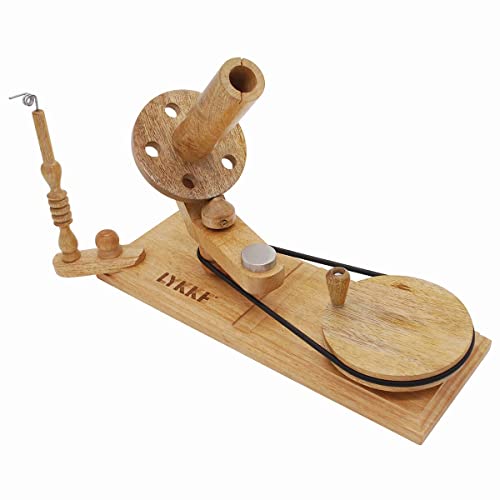
LYKKE mango wood ball winder
The approved exact retail record identifies LYKKE's mango-wood hand winder; the current brand catalog confirms its ball-winder family.
- Mango wood (listing)
- Hand operated
- Five-year manufacturer-defect warranty (brand)
Consider: Confirm exact capacity, clamp opening and model-specific care. LYKKE's five-year defect warranty is not a durability test or fit specification.
Check on AmazonPrice, seller and availability are shown on Amazon.
Common questions
Are wooden yarn winders quieter?
Wood alone does not establish noise level. We would need evidence for the exact model and operating conditions to make that comparison.
Should I oil a wooden winder?
Only follow the maker's care instructions. Advice for a swift, a drive band or a different winder is not interchangeable.
Does a wooden swift have to match the winder?
No. Check their working sizes and placement. Matching material or color is optional.
How much yarn can the KnitPro wooden winder hold?
KnitPro states that its current wooden ball winder can hold up to 450 g, or about 15 oz, of fingering-weight yarn. That yarn-specific maker claim is not a promise that every bulky or lofty 450 g yarn will fit.
How do I use a wooden yarn winder?
Use the exact model manual. In general, secure the winder to a suitable surface, align and thread its guide, start slowly, keep the yarn supply moving freely and stop if the feed catches or the machine shifts.
Sources & further reading
Sources below support the claims identified in this guide. Product details may come from manufacturer documentation or clearly labeled retailer or listing evidence. We have not physically tested these products.
- KnitPro current wooden ball winder specifications
- KnitPro yarn ball winder care guide
- KnitPro replacement band set
- LYKKE official guarantee
- LYKKE current brand catalog
Found an error? Send a correction.
Return to our main yarn winder guide to compare winder types, capacity and table fit, or use the Winder Finder to narrow researched candidates.